
What people get wrong about Autokinetic effect.
The autokinetic effect is a phenomenon of visual perception in which a stationary, small point of light in an otherwise dark or featureless environment appears to move.
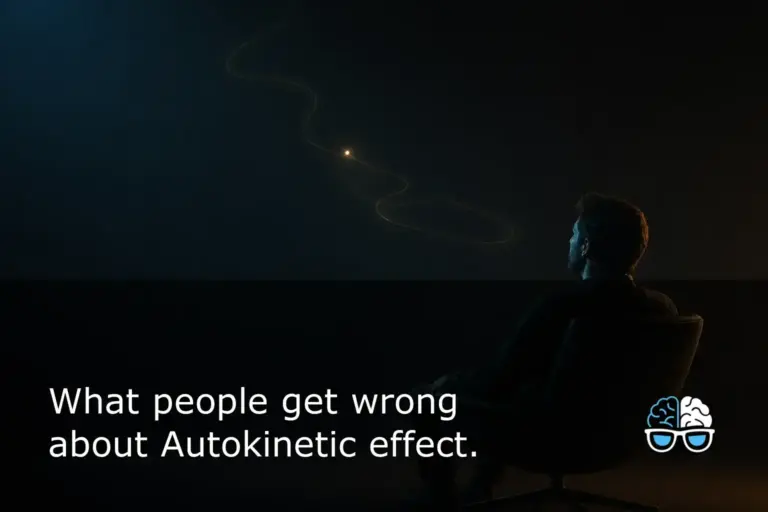
The autokinetic effect is a phenomenon of visual perception in which a stationary, small point of light in an otherwise dark or featureless environment appears to move.
The autokinetic effect is a phenomenon of visual perception in which a stationary, small point of light in an otherwise dark or featureless environment appears to move. It was first recorded in 1799 by Alexander von Humboldt who observed illusory movement of a star in a dark sky, although he believed the movement was real. It is presumed to occur because motion perception is always relative to some reference point, and in darkness or in a featureless environment there is no reference point, so the position of the single point is undefined. The direction of the movements does not appear to be correlated with involuntary eye movements, but may be determined by errors between eye position and that specified by efference copy of the movement signals sent to the extraocular muscles. Richard Gregory suggested that, with lack of peripheral information, eye movements which correct movements due to muscle fatigue are wrongly interpreted as movement of the perceived light.
Sources