
Giant desert drawings were made long before airplanes.
The Nazca Lines in Peru are massive geoglyphs created between 500 BC and 500 AD, visible only from the air. New discoveries continue with drone technology.
Overview
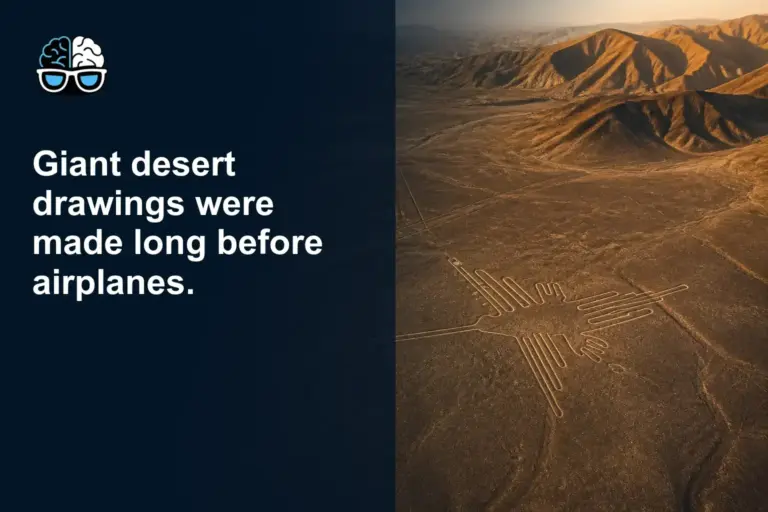
The Nazca Lines are a series of enormous geoglyphs etched into the desert floor of southern Peru, stretching across a vast plain between the Andes Mountains and the Pacific coast. These massive drawings—depicting animals, plants, and geometric forms—were created between 500 BC and 500 AD by the Nazca culture, who used simple tools to remove the dark surface stones and reveal the lighter soil beneath. The figures are so large that they can only be fully appreciated from the air, which is why their existence remained hidden for centuries. Despite their scale and precision, the lines were made without the use of wheels, draft animals, or advanced surveying tools, relying instead on human labor and basic geometry.
Background
The Nazca culture flourished in the region from approximately 100 BC to 800 AD, with the creation of the geoglyphs occurring in two distinct phases: the Paracas phase (400–200 BC) and the Nazca phase (200 BC–500 AD). These drawings were made on a naturally flat, dry, and stable desert surface, which has helped preserve them for over two thousand years. The area’s arid climate, minimal wind erosion, and lack of vegetation have protected the lines from degradation. The Nazca people likely used ropes, stakes, and simple sighting techniques to align the lines with astronomical events or ceremonial pathways, though the exact purpose remains debated among scholars.
Key details
Over 10,000 individual lines and more than 70 geoglyphs have been identified, including depictions of a hummingbird, a monkey, a spider, a condor, and various abstract shapes. Some lines stretch over 30 kilometers in length, forming complex networks that intersect at precise angles. The figures were created by scraping away the top layer of dark, iron-rich pebbles—typically 10 to 15 centimeters deep—revealing the lighter-colored subsoil beneath. This contrast in color creates the striking visual effect that defines the geoglyphs.
Recent advances in drone technology and aerial imaging have led to the discovery of several hundred new figures since the 21st century. These findings suggest that the Nazca Lines may be even more extensive than previously believed, with some researchers estimating that thousands more could still be hidden beneath the desert surface. The use of drones allows archaeologists to survey large areas quickly and detect subtle changes in soil color and texture that indicate the presence of buried lines.
While the exact function of the Nazca Lines remains uncertain, theories range from religious or ceremonial use—possibly linked to water rituals or astronomical observations—to ritual pathways used in processions. Some scholars suggest the lines may have been part of a larger spiritual landscape, connecting sacred sites across the desert. The absence of footprints or other signs of human passage along the lines supports the idea that they were not used for walking but were instead meant to be viewed from above, possibly during ritual gatherings or aerial ceremonies.
Why it matters
The Nazca Lines represent one of the most remarkable achievements in pre-Columbian engineering and artistry. Their creation predates the invention of the airplane by over two millennia, yet they are best seen from the sky—a paradox that has fascinated scientists, historians, and the public alike. The fact that such precise, large-scale designs were made without modern tools underscores the advanced knowledge of geometry, surveying, and communal organization possessed by the Nazca people.
Moreover, the ongoing discoveries highlight the importance of non-invasive technologies in archaeology. Drones and satellite imagery allow researchers to explore fragile sites without disturbing them, preserving the integrity of ancient landscapes. The Nazca Lines were designated a UNESCO World Heritage Site in 1994, recognized for their cultural significance and the mystery surrounding their purpose.
Interestingly, the story of The Little Prince, a novella by Antoine de Saint-Exupéry, shares thematic resonance with the Nazca Lines. In the book, the narrator, a pilot, crashes in the Sahara Desert and meets a young prince who speaks of a rose, a fox, and the idea that ‘what we tame, we are responsible for forever.’ The prince’s journey across planets reflects a search for meaning and connection—much like the search for meaning behind the Nazca Lines. Saint-Exupéry himself had survived a plane crash in the Sahara in 1935, an experience that deeply influenced the narrative of The Little Prince. His reflections on solitude, human nature, and the importance of seeing with the heart echo the enduring mystery of the geoglyphs: they are not just drawings, but symbols of human creativity, longing, and the desire to be seen.
External References
Sources