2005: Live 8 Goes Global
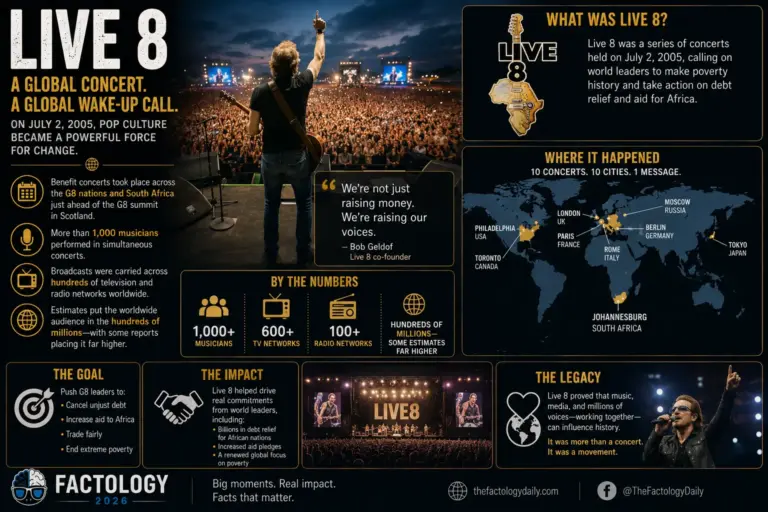
On July 2, 2005, Live 8 held simultaneous benefit concerts across G8 nations and South Africa, featuring over 1,000 musicians to urge G8 leaders on poverty relief.
Overview
On July 2, 2005, a series of benefit concerts known as Live 8 took place in the eight G8 countries and South Africa. The shows were scheduled to precede the G8 summit held at Gleneagles Hotel in Scotland from July 6 to 8, 2005. Organised by Bob Geldof and Midge Ure, the concerts supported the UK’s Make Poverty History campaign and the Global Call to Action Against Poverty. More than 1,000 musicians performed across ten simultaneous venues on July 2, with an additional event in Edinburgh on July 6. The concerts were free to attend, though tickets for the London Hyde Park show were distributed via a text‑message competition that generated over two million entries and raised £3 million for charity. Broadcasts reached hundreds of television and radio stations worldwide, with audience estimates ranging from tens of millions to over two billion viewers.
Background
Live 8 was conceived as a follow‑up to the 1985 Live Aid initiative, marking the twentieth anniversary of that earlier effort. Bob Geldof announced the plan on May 31, 2005, after discussions with fellow organiser Midge Ure. Although early press reports referred to the project as “Live Aid 2,” Geldof publicly distinguished the new concerts as the start of a longer campaign he called “The Long Walk to Justice.” The Make Poverty History coalition, which had already organised protests and advocacy work, partnered with the event. The timing was deliberate: the concerts were set for July 2, just days before the G8 leaders gathered in Scotland to discuss global economic policy. In addition to the main shows, a separate rally and anti‑poverty march took place in Edinburgh on the same day, drawing an estimated 225,000 participants and becoming the largest protest ever held in Scotland. The event also featured appearances by public figures such as UN Secretary‑General Kofi Annan, Microsoft co‑founder Bill Gates, and former South African President Nelson Mandela, who spoke at the Johannesburg venue.
Key details
Ten concerts were held simultaneously on July 2, 2005, beginning with the show at Makuhari Messe in Japan, where the band Rize performed first. The London concert in Hyde Park opened with U2 and Paul McCartney playing “Sgt. Pepper’s Lonely Hearts Club Band,” and later featured a reunion of Pink Floyd’s classic line‑up—Roger Waters, David Gilmour, Richard Wright and Nick Mason—who performed tracks including “Speak to Me,” “Breathe,” “Money,” “Wish You Were Here” and “Comfortably Numb.” Bob Geldof closed the London set with a spontaneous rendition of “I Don’t Like Mondays.” In Philadelphia, Will Smith led a coordinated finger‑snapping gesture involving audiences in London, Philadelphia, Berlin, Rome, Paris and Barrie, intended to represent the death of a child every three seconds in Africa. The Johannesburg venue featured an address by former President Nelson Mandela, while the London stage also hosted speeches by UN Secretary‑General Kofi Annan and Bill Gates. Additional performances included Mariah Carey’s “Hero,” Coldplay’s “In My Place” with a chorus from Status Quo’s “Rockin’ All Over the World,” and a joint set by Jay‑Z and Linkin Park performing “Numb/Encore.” The Berlin showcase highlighted Brian Wilson and Green Day, and the Moscow bill featured Russian acts such as Bi‑2 and Splean. The final event, Edinburgh 50,000 – The Final Push, took place at Murrayfield Stadium on July 6 and included artists from the earlier shows. Broadcasts were carried on 182 television networks and 2,000 radio networks. Audience estimates varied: Nielsen recorded 3 million viewers in the United States, the BBC suggested a global figure of about 1.5 billion, and other sources placed the total as high as 2 billion. Ticket allocation for the Hyde Park concert involved 66,500 pairs awarded through a text‑message competition that generated over two million messages and raised £3 million, with the first £1.6 million directed to the Prince’s Trust and the remainder covering event costs. Some ticket winners attempted to resell their tickets on eBay, prompting criticism from organisers and eventually leading eBay to withdraw the auctions after pressure from the British government, the public and Bob Geldof.
Why it matters
The concerts were intended to pressure the G8 leaders attending the Gleneagles summit to increase aid, forgive debt and ease trade restrictions for African nations. During the summit, the leaders pledged to double 2004 levels of aid to poor countries from US$25 billion to US$50 billion by 2010, with half of the increase earmarked for Africa. Prior to the meetings, organisers presented a “Live 8 List” of names to the leaders, which was displayed on giant screens at each venue. After the events, a documentary special titled Live 8: What a Difference a Day Makes aired on BBC One, CTV and MTV in July 2006. An official DVD set of the concerts was released internationally on 7 November 2005 and in the United States on 8 November 2005. A 115‑track live album drawn from performances was issued on 28 May 2019.
External References
For more information, see the Live 8 article on Wikipedia.
Sources