
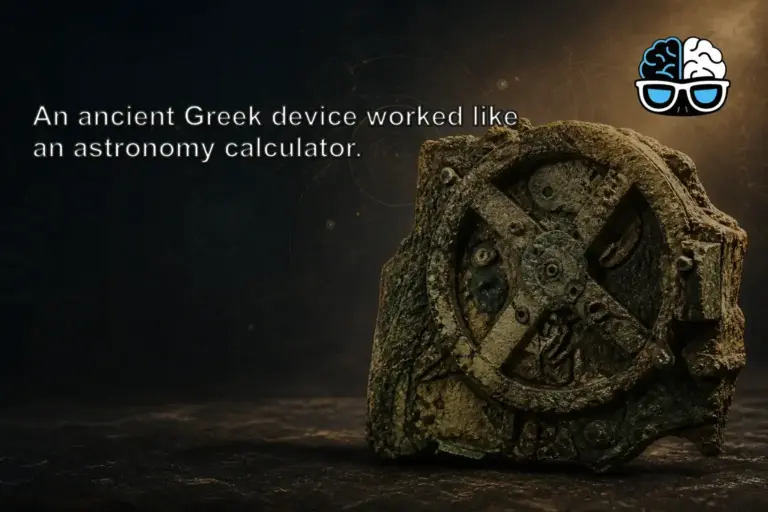
An ancient Greek device worked like an astronomy calculator.
Discover the Antikythera mechanism, an ancient Greek analog computer that used gears to predict astronomical events over 2,000 years ago.
Overview
The Antikythera mechanism stands as a remarkable testament to the advanced scientific and engineering capabilities of ancient Greece. Discovered in a shipwreck off the coast of the Greek island Antikythera, this intricate device is considered the world’s oldest known analog computer. Its complex arrangement of gears allowed ancient astronomers to model and predict celestial movements, including the positions of the Sun and Moon, and even predict astronomical events like eclipses, decades into the future. It also tracked cycles of athletic games, such as the ancient Olympic Games.
Background
Astronomy has been a fundamental science for civilizations throughout history, driven by the need to understand the cosmos. Early astronomical practices were deeply intertwined with religious beliefs, mythology, timekeeping, navigation, and agricultural planning. Civilizations across the globe, including the Babylonians, Chinese, Central Americans, and Europeans, developed sophisticated methods for observing and charting the night sky. The Babylonians, for instance, developed early star catalogues and applied mathematics to predict celestial phenomena, with records dating back to around 1000 BC. In India, astronomical texts like the Vedanga Jyotisha, dating to approximately 1350 BC, describe rules for tracking the Sun and Moon for ritualistic purposes. The Greeks, however, elevated astronomy to a highly sophisticated mathematical discipline.
During the 4th century BC, Greek thinkers like Eudoxus of Cnidus and Callippus of Cyzicus developed the first geometrical, three-dimensional models of planetary motion, based on nested spheres centered on the Earth. Heraclides Ponticus later proposed that the Earth rotates on its axis. Natural philosophers like Plato and Aristotle focused more on explaining the underlying reasons for celestial movements, with Aristotle proposing a complex system of concentric spheres that would influence cosmological thought for centuries. Aristarchus of Samos, in the 3rd century BC, was the first to propose a heliocentric system, though his ideas were not widely adopted at the time. Eratosthenes achieved remarkable accuracy in calculating the Earth’s circumference.
By the 2nd century BC, Greek geometrical astronomy evolved to incorporate more complex models, such as epicycles (smaller circles carrying planets that moved along larger eccentric circles). Hipparchus of Nicea made significant contributions, including the first measurement of the precession of the equinoxes and the creation of the first star catalog using a system of apparent magnitudes. It was within this rich intellectual and technological environment that the Antikythera mechanism was conceived and built.
Key details
The Antikythera mechanism, dating from approximately 150–100 BC, is a prime example of the sophisticated astronomical instruments developed by the ancient Greeks. Its discovery in an ancient shipwreck near the island of Antikythera provided unprecedented insight into the mechanical ingenuity of the era. The device is essentially a hand-powered orrery, a mechanical model of the solar system. Its complexity lies in its intricate system of bronze gears, which allowed it to perform highly accurate calculations.
One of the most astonishing features of the Antikythera mechanism is its use of a differential gear. This type of gear, which allows for the calculation of the difference between two input motions, was long believed to have been invented in the 16th century, making its presence in a device over 1,500 years older a profound revelation. The miniaturization and complexity of its many interlocking gears were comparable to that of 18th-century clockwork, a level of precision previously thought unattainable for ancient technology.
The mechanism was capable of tracking the movements of the Sun and the Moon with remarkable accuracy. It could also predict lunar phases and eclipses, calculating their occurrence decades in advance. Beyond its astronomical functions, the Antikythera mechanism also incorporated a dial that tracked the four-year cycle of athletic games, including the ancient Olympic Games, demonstrating a unique integration of celestial and terrestrial timekeeping.
Why it matters
The Antikythera mechanism fundamentally reshaped our understanding of ancient Greek technological capabilities. It demonstrated that the Greeks possessed a level of mechanical engineering and astronomical calculation far beyond what was previously assumed. The device serves as the earliest known example of an analog computer, predating similar inventions by over a millennium. Its sophisticated gearing system and the inclusion of a differential gear highlight a deep understanding of mechanical principles and mathematical astronomy.
The mechanism’s ability to predict astronomical events and track complex cycles underscores the advanced observational and theoretical knowledge of ancient astronomers. It provides tangible evidence of their efforts to quantify and model the cosmos, moving beyond purely philosophical or religious explanations. The Antikythera mechanism is not just a historical artifact; it is a symbol of human ingenuity and the enduring quest to understand our place in the universe, showcasing a remarkable fusion of science, mathematics, and engineering in the ancient world.
External References
Sources