
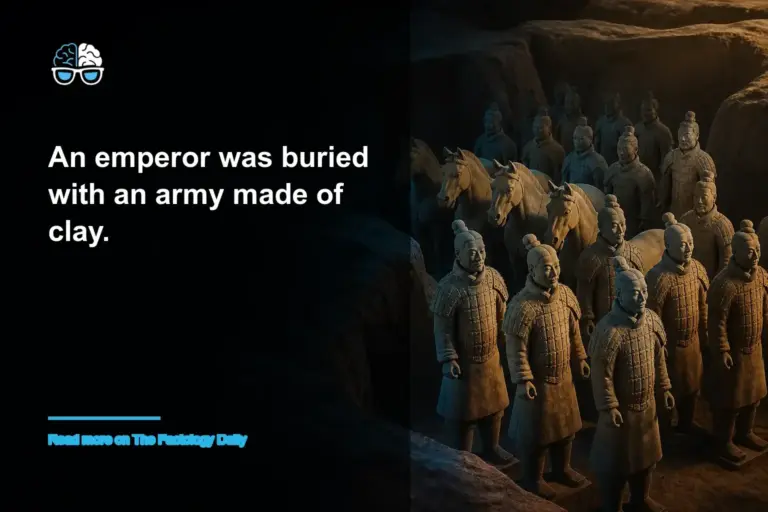
An emperor was buried with an army made of clay.
Discover the Terracotta Army, a vast collection of clay soldiers buried with China's first emperor, Qin Shi Huang, to guard him in the afterlife.
Overview
The Terracotta Army is a monumental collection of terracotta sculptures depicting the armies of Qin Shi Huang, the first emperor of a unified China. This extraordinary funerary art was buried with him around 210–209 BCE, intended to protect him in his afterlife. Discovered in 1974 by farmers digging a well near Lintong County, outside Xi’an, Shaanxi, China, the army comprises over 8,000 life-sized terracotta soldiers, 130 chariots with 520 horses, and 150 cavalry horses, all arranged in military formations. The figures vary in height according to their rank, with generals being the tallest. In addition to the military figures, other non-military terracotta sculptures have been found, including officials, acrobats, strongmen, and musicians, showcasing a broader spectrum of Qin society.
Background
The construction of Qin Shi Huang’s mausoleum began in 246 BCE, shortly after he ascended to the throne as King of Qin at the young age of 13. The historian Sima Qian, writing a century later in his seminal work, the Records of the Grand Historian, stated that the project eventually involved an estimated 700,000 conscripted laborers. The chosen location at Mount Li was considered auspicious due to its geological qualities, described by geographer Li Daoyuan as being rich in jade and gold, believed to offer spiritual protection. Sima Qian’s account also describes the mausoleum as containing palaces, towers, officials, and a simulated underground landscape with 100 flowing rivers simulated using mercury, and a ceiling decorated with celestial bodies. While some elements of his account were once considered fanciful, the detection of high levels of mercury in the tomb mound’s soil has lent credence to his descriptions. The emperor was also known for commissioning monumental statues, such as the now-lost Twelve Metal Colossi, further indicating his penchant for large-scale artistic projects.
Later historical accounts suggest that the mausoleum complex may have been looted and burned by Xiang Yu, a rival claimant to the throne after the emperor’s death. Evidence of fire damage and collapsed structures within some pits supports this theory, although the main tomb itself may have remained intact.
Key details
The Terracotta Army is part of a much larger necropolis, estimated to cover approximately 98 square kilometers. The army itself is housed in four main pits, located about 1,500 meters east of the main tomb mound. These pits were excavated to a depth of about 7 meters and were designed to protect the tomb from the east, the direction from which the emperor’s conquered states lay.
Pit 1 is the largest, measuring 230 meters long and 62 meters wide, containing over 3,000 soldiers arranged in eleven parallel corridors. These corridors, resembling palace hallways with wooden ceilings covered by reed mats and clay, would have been waterproofed and mounded with soil. Pit 2 contains cavalry, infantry, and war chariots, thought to represent a military guard. Pit 3 serves as the command post, featuring high-ranking officers and a war chariot. Pit 4, however, remains empty, possibly indicating that construction was unfinished.
The warrior figures are life-sized, typically ranging from 1.75 to 2 meters tall, with officers generally being taller. They vary in height, uniform, and hairstyle according to their rank. A remarkable aspect is the individuality of each figure’s face; scholars have identified at least ten base facial molds that were then modified with hand-added clay to ensure no two faces are identical. The figures represent various types of soldiers, including armored and unarmored infantry, cavalrymen, chariot drivers, and archers, each with distinct armor and attire reflecting their role and rank.
Originally, the figures were adorned with vibrant pigments derived from minerals and plants, including cinnabar (red), malachite (green), azurite (blue), and a rare synthetic pigment known as Chinese purple. However, the dry air of Xi’an causes this delicate paint to flake off rapidly, often within minutes of excavation, making preservation a significant challenge. The sculptures were manufactured using an assembly-line process: heads, arms, legs, and torsos were created separately using molds and then assembled. Craftsmen were required to inscribe their workshop names on the figures, a practice that aids modern researchers in tracing production origins.
While most figures originally held real weapons, these were largely looted or have deteriorated. However, over 40,000 bronze items, including swords, daggers, spears, and arrowheads, have been recovered. Some swords were found to have a thin layer of chromium, initially thought to be an anti-corrosion treatment, but recent research suggests this was likely contamination rather than a deliberate measure. The preservation of metal artifacts is attributed to the slightly alkaline pH and fine particles of the burial soil.
Beyond the military figures, other pits have yielded non-military terracotta sculptures. These include acrobats, strongmen, musicians, and officials. The acrobats, in particular, display advanced anatomical detail and dynamic poses, demonstrating a high level of artistic skill and a sophisticated understanding of human anatomy. Despite some speculation about possible Hellenistic or Greek influences due to the naturalism of the figures, experts emphasize that there is no substantial evidence to support such direct links, attributing the realism to local artistic traditions and the modeling of actual soldiers.
In 2003, a mass grave pit containing 121 skeletons, predominantly young adults aged 15 to 40, was discovered. DNA analysis suggests a diverse workforce, including individuals from southern China and minority ethnic groups, highlighting the large-scale mobilization of people across the empire for this monumental project. The human cost of such imperial ambition is underscored by the discovery of these laborers, believed to have died during construction.
Why it matters
The Terracotta Army offers an unparalleled window into the scale, organization, and ideology of the Qin Dynasty. It vividly illustrates the emperor’s belief in an afterlife where he would continue to rule, protected by a formidable military force. The sheer number of figures and the precision of their arrangement underscore the centralized power and logistical capabilities of the early imperial Chinese state. The discovery also serves as a crucial reminder of the importance of archaeological preservation. The rapid degradation of the paint on the figures after excavation highlights the delicate nature of ancient materials and the need for careful handling and conservation techniques.
Furthermore, the necropolis reveals the human dimension behind imperial grandeur. The discovery of the mass grave of laborers points to the immense human cost involved in constructing such monumental projects. The diverse origins of these workers, as indicated by DNA analysis, suggest a vast mobilization of people from across the empire, underscoring the reach and power of Qin Shi Huang’s rule. The Terracotta Army is not just a testament to ancient artistry and military might, but also a poignant reminder of the lives and labor that contributed to its creation.
External References
Sources