
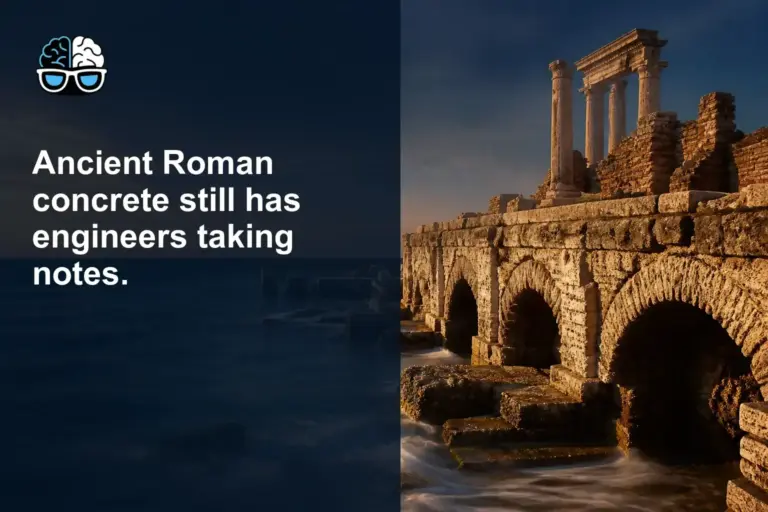
Ancient Roman concrete still has engineers taking notes.
Ancient Roman concrete, known as opus caementicium, remains durable after centuries. Researchers study its volcanic-based mortar for insights into long-lasting construction materia
Overview
Some of the most enduring structures in human history were built using a type of concrete developed by ancient Romans over two millennia ago. Known as opus caementicium, this material enabled the construction of monumental buildings, aqueducts, roads, and dams that have withstood centuries of environmental exposure. Unlike modern concrete, which often degrades over time, Roman concrete has demonstrated remarkable durability, particularly in marine environments. Today, engineers and material scientists study its composition to understand how it resists cracking and erosion, seeking to replicate its longevity in contemporary construction.
Background
The Romans were not the first to use concrete-like materials, but they refined and expanded its application on an unprecedented scale. Their construction techniques were rooted in a blend of practical experimentation and borrowed knowledge from earlier civilizations, including the Greeks, Etruscans, and Celts. The Roman Empire’s vast infrastructure—spanning from Britain to North Africa—relied heavily on durable building materials, especially in urban centers like Rome and Constantinople. A key factor in the longevity of Roman structures was the use of volcanic materials, particularly a fine ash known as pozzolana, which was abundant near Naples. This ash, when mixed with lime and water, created a hydraulic cement that hardened even underwater, a property critical for port construction and aqueducts.
Building materials in ancient Rome included stone, wood, marble, and various mortars. Stone was quarried locally to reduce transport costs, with blocks extracted using wooden wedges and water to split the rock. Wood was treated with alum to make it fireproof. However, it was the development of specialized cements and mortars that set Roman construction apart. The Romans adapted their mortar recipes based on the source of sand—coastal or inland—adjusting the ratio of sand to lime and adding crushed shells for coastal mixes. The most significant innovation was pozzolana mortar, which formed a dense, rock-like matrix capable of withstanding water, pressure, and time.
Key details
One of the most iconic examples of Roman concrete is the Pantheon in Rome. Completed in the 2nd century CE, its massive dome remains the world’s largest unreinforced concrete dome. The dome’s strength and stability stem from the use of a lightweight concrete mix that included pozzolana and volcanic ash. The composition allowed the concrete to cure without needing to dry completely, enabling the construction of thick, self-supporting walls and domes. The dome’s design also incorporated mathematical precision, with 28 coffers embedded in the ceiling—each corresponding to the number 28, a perfect number in mathematics, reflecting the Romans’ integration of symmetry and proportion into engineering.
Another example is the Hagia Sophia in Constantinople, built after the fall of the Western Roman Empire but using Roman techniques. Its construction relied on pozzolana mortar made not with volcanic ash but with crushed brick dust. This adaptation increased the mortar’s tensile strength from about 200 kilopascals (typical for lime-only mortar) to 3,000 kilopascals. The high tensile strength allowed for wider mortar joints, a design choice that suggests engineers understood the material’s properties and intentionally used them to enhance structural integrity. The slow curing time of the mortar also caused structural sagging during construction, requiring engineers to remove decorative walls to allow proper setting.
Roman aqueducts, such as the Aqua Claudia and Aqua Marcia, were built to transport water over long distances using gravity. These systems spanned hundreds of kilometers and included underground channels, surface-level conduits, and elevated arches. To prevent erosion, the channels were lined with opus signinum—a plaster made from crushed terracotta mixed with pozzolana and lime. This protective layer helped maintain water quality and structural stability. In places where terrain required water to flow uphill, inverted siphons were used, demonstrating advanced hydraulic engineering.
Roman dams, such as the Subiaco Dams in Italy, were built to feed major aqueducts. The Romans constructed over 70 dams in Spain alone, and some remain functional today. In Galicia, a dam across the River Sil was used to expose gold deposits, indicating the integration of engineering with mining. In Britain, a well-preserved earthen dam at Longovicium may have supported industrial smelting, as evidenced by slag piles nearby. The Romans also adopted and improved wadi irrigation in Egypt, capturing seasonal floodwater for agricultural use.
Why it matters
The durability of Roman concrete offers valuable lessons for modern construction. Today’s concrete often suffers from cracking and degradation due to chemical reactions and environmental stress. In contrast, Roman concrete’s use of pozzolana creates a self-healing effect: over time, calcium-aluminum-silicate-hydrate (C-A-S-H) crystals form in cracks, sealing them and preventing further damage. This natural repair mechanism is being studied to develop more sustainable, long-lasting building materials.
Modern engineers are exploring the use of volcanic ash and other pozzolanic materials in cement production to reduce carbon emissions and improve longevity. The Roman approach—using locally available, natural materials—also aligns with contemporary sustainability goals. By understanding how ancient builders achieved such resilience with limited technology, today’s architects and scientists can innovate without relying on synthetic additives or excessive energy use.
External References
Sources