
The Antikythera Mechanism Was an Ancient Calculator
Explore the Antikythera mechanism, an ancient Greek gear‑driven device that modeled celestial motions and predicted eclipses, revealing Hellenistic engineering.
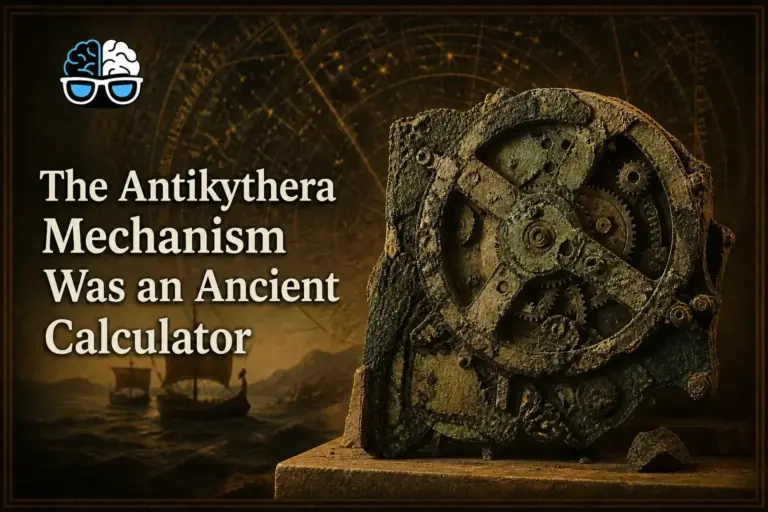
Overview
The Antikythera mechanism is a hand‑powered Greek device built in the second century BC that modeled the motions of the Sun, Moon and possibly the five known planets. It is regarded as the oldest known analogue computer, capable of predicting astronomical positions and eclipses decades ahead.
Recovered from a Roman shipwreck near the island of Antikythera in 1901, the artefact was found inside a wooden frame roughly 34 × 18 × 9 cm. The bronze gears were encased in corrosion that had transformed the metal into atacamite, which cracked and shrank when the object was lifted from seawater, altering its original dimensions.
Beyond eclipse prediction, the device incorporated dials that tracked the four‑year cycle of the Panhellenic games, similar to an Olympiad, and featured a parapegma—an early almanac—marking the positions of prominent stars. This combination of calendrical, athletic and stellar information suggests the mechanism served both practical and scholarly purposes for its elite users.
Background
Captain Dimitrios Kontos and a crew of sponge divers from Symi island located the wreck in early 1900 and recovered the mechanism in July 1901 alongside bronze statues, pottery, glassware, jewellery and coins. All objects were taken to the National Archaeological Museum in Athens for storage and analysis.
Initially the lump of corroded bronze and wood attracted little attention; it remained unnoticed for two years while conservators worked on more conspicuous finds such as the statues. On 17 May 1902 archaeologist Valerios Stais, together with his cousin Spyridon Stais, observed a gear wheel embedded in a fragment, prompting the first systematic study. Most scholars considered the device too advanced for its era, but the German philologist Albert Rehm was the first to propose that it functioned as an astronomical calculator.
Interest in the mechanism revived in 1951 when British science historian Derek J. de Solla Price began studying the fragments. In 1971 he collaborated with Greek nuclear physicist Charalampos Karakalos to produce X‑ray and gamma‑ray images of all 82 pieces. Price’s 1974 publication presented a reconstruction that identified the gear train and proposed the device’s use for predicting lunar and solar eclipses, establishing the mechanism as a genuine ancient analogue computer.
Key details
After recovery the mechanism was found as a single encrusted mass that later fractured into three main pieces. Conservation work eventually separated the material into 82 distinct fragments; seven of these are mechanically significant and contain the bulk of the gears and inscriptions, while another sixteen hold only partial markings.
The largest surviving gear measures about 13 cm in diameter and originally possessed 223 teeth. X‑ray tomography and high‑resolution scanning carried out by a Cardiff University team in 2005 revealed that the mechanism contained 37 meshing bronze gears. These gears reproduce the Moon’s uneven motion—its faster speed at perigee and slower speed at apogee—using epicyclic arrangements that follow the theory developed by the astronomer Hipparchus of Rhodes.
Inscriptions on many fragments reference the Metonic (19‑year) and Saros (223‑lunar‑month) eclipse cycles, the 76‑year Callippic cycle, and, after work in 2016, numbers tied to the synodic periods of Venus and Saturn. The front face displays a fixed zodiac ring with the twelve Greek signs and a rotatable outer ring marked with Egyptian month names transcribed into the Greek alphabet; rotating this outer ring aligns the calendar with the current zodiac position.
On the rear of the mechanism two large spiral dials display the Metonic and Saros cycles; each pointer travels along a groove that makes four or five full turns before reaching the end, at which point a follower must be manually shifted to the opposite side to continue the count. These dials also incorporate indicators for the Callippic cycle and the timing of the Panhellenic games, allowing the user to read long‑term astronomical and calendrical information from a single instrument.
Operation relied on a small hand crank linked to a crown gear that drove the largest four‑spoked gear visible on fragment A. Turning the crank advanced the date pointer on the front dial by about seventy‑eight degrees per revolution, which corresponds roughly to seventy‑eight days on the Egyptian calendar scale. As the crank turned, the entire gear train rotated, simultaneously calculating the Sun’s position, the Moon’s phase, eclipse risk and the various cycle indicators on the back dials.
Why it matters
The mechanism shows that Hellenistic craftsmen could build gear systems far more complex than anything previously known from the archaeological record. Its capacity to predict eclipses and planetary positions decades ahead demonstrates a practical application of the mathematical theories developed by Greek scholars such as Hipparchus and, through possible links to Corinthian colonies, perhaps the school of Archimedes.
The use of epicyclic gearing to model the Moon’s elliptical orbit represents the earliest known example of this technique, predating similar European devices by more than a thousand years. No comparable technological sophistication reappeared until the fourteenth‑century astronomical clocks of Richard of Wallingford and Giovanni de’ Dondi. Moreover, the inscriptions reveal Babylonian arithmetic methods being woven into Greek astronomical practice, underscoring a cross‑cultural exchange of scientific knowledge.
The Antikythera mechanism forces a reassessment of the technological capabilities of the Hellenistic period, showing that sophisticated gear cutting and precision machining were available centuries before the medieval revival of clockwork. Its discovery has inspired modern reconstructions, scholarly debates about its possible creators, and ongoing underwater investigations at the wreck site seeking additional fragments.
External References
Learn more: Antikythera mechanism – Wikipedia.
Sources