
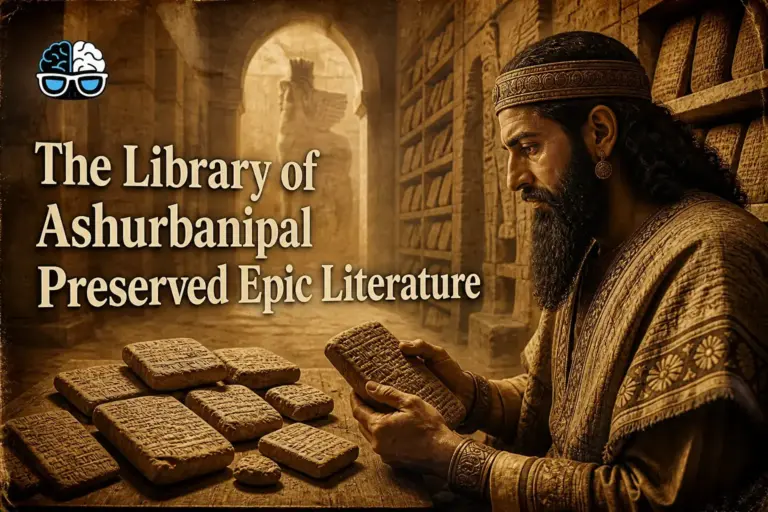
The Library of Ashurbanipal Preserved Epic Literature
The Library of Ashurbanipal at Nineveh preserved over 30,000 clay tablets, including the Epic of Gilgamesh, showing clay’s durability as information technology.
Overview
n
The Library of Ashurbanipal, situated in the ancient city of Nineveh (modern northern Iraq), comprised more than 30,000 clay tablets and fragments assembled during the seventh century BCE. Collected under King Ashurbanipal, the last great ruler of the Assyrian Empire, the library held a wide range of texts—literary, administrative, scientific, and religious. Its most celebrated item is the Epic of Gilgamesh, a Babylonian poem that scholars have reconstructed largely from these tablets. The collection demonstrates how fired clay could serve as a durable medium for preserving information across millennia.
n
Background
n
Modern awareness of the library began with the excavations of Austen Henry Layard in late 1849 at the South‑West Palace of Nineveh. Three years later, Layard’s assistant Hormuzd Rassam uncovered a second group of tablets in the palace of King Ashurbanipal on the opposite side of the mound. Although the original discovery was not formally recorded, the tablets were later shipped to Europe where they became mixed with material from other sites, complicating attempts to reconstruct each library’s original contents. Today, the British Museum holds 30,943 individual tablet fragments from the Nineveh collection, the majority of which are stored in its Department of the Middle East.
n
Key details
n
The library’s holdings consist of approximately 30,000 tablets and writing boards, the majority of which are severely fragmented. Scholars estimate that the intact collection may have contained close to two thousand tablets and about three hundred writing boards at the time of its destruction. About six thousand tablets record colloquial material such as legislation, foreign correspondence, aristocratic declarations, and financial records. The legal document group comprises 1,128 Babylonian tablets and fragments, while the literary composition group includes 1,331 tablets classified as divination, religious, lexical, medical, mathematical, historical texts, epics, and myths. Within the literary group, divination texts split into 759 “library texts” (omen series and their commentaries) and 636 “archival texts” (omen reports and oracle enquiries). The Epic of Gilgamesh, the Enûma Eliš creation story, the myth of Adapa, and the Poor Man of Nippur are among the literary works identified. Only ten tablets in the collection contain expressive rhythmic literary works such as epics and myths. The library also held twenty fragments of archaic cuneiform sign lists, one arranged according to syllabary A and another according to syllabary B, which Assyrian scribes used to read older inscriptions. Tablets were often sorted by shape—four‑sided tablets were used for financial transactions, round tablets for agricultural information—and placed in rooms labelled for government, history, law, astronomy, geography, and similar subjects. Contents were identified by coloured marks, brief written descriptions, or the incipit (the opening words) of each text. The library’s destruction in 612 BCE, when a coalition of Babylonians, Scythians, and Medes burned Nineveh, exposed the clay tablets to fire; the partial baking helped preserve them, while organic media such as wax boards have not survived. A large share of the original collection consisted of writing‑boards rather than clay tablets, and if all smaller fragments that belong to the same text are deducted, the library may have originally comprised some 10,000 distinct texts.
n
Why it matters
n
The Ashurbanipal library offers one of the most direct windows into the intellectual life of the ancient Near East. H. G. Wells described it in his Outline of History as “the most precious source of historical material in the world.” Modern scholars have used its tablets to reconstruct the Epic of Gilgamesh, a foundational work of world literature, and to study Babylonian divination, medicine, astronomy, and law. The survival of the clay tablets illustrates how fired clay can act as a long‑lasting information technology, preserving texts that would otherwise have been lost on more perishable media. Ongoing projects such as the British Museum’s Ashurbanipal Library Project, launched in 2002, continue to catalogue, translate, and image the tablets, making the collection accessible to researchers worldwide. The project has proceeded in stages: the first stage produced an authoritative list of 3,500 Babylonian‑script tablets; the second added astrological texts from Nineveh; the third, completed with support from the Andrew Mellon Foundation, delivered high‑resolution digital images of each tablet created from 14 photographs to simulate a two‑dimensional view. As of 2020‑2023, a collaborative effort titled Reading the Library of Ashurbanipal examined the colophons—scribal notes at the end of tablets—to understand how and why the collection was assembled, involving scholars from the British Museum and LMU Munich. Institutions including the Hermitage, the Louvre, the Vatican Museums, the Penn Museum, the Kunsthistorisches Museum, and the de Liagre Böhl collection have contributed material to the project.
n
External References
n
For further reading, see the Wikipedia article on the Library of Ashurbanipal.
Sources