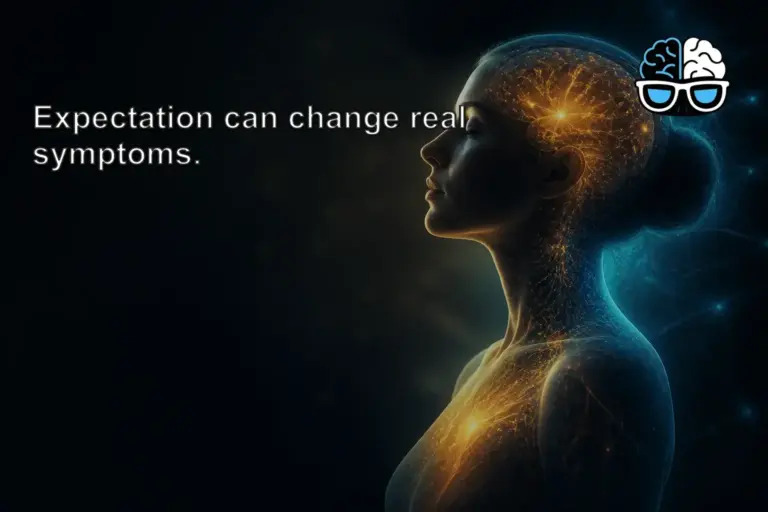
Expectation can change real symptoms.
Expectation influences physical symptoms through placebo effects, demonstrating how mental states can alter biological outcomes via brain-body interactions
Overview
Expectation plays a powerful role in shaping real physical symptoms, a phenomenon well-documented in medical science through the placebo effect. When individuals believe a treatment will help, their brains can trigger measurable biological changes that reduce pain, improve function, or alter immune responses—even when the treatment contains no active pharmaceutical ingredients. This effect underscores the profound influence of psychological context on physiology, revealing that the mind is not separate from the body but deeply involved in its regulation.
Background
Placebos—substances or procedures designed to mimic real treatments without therapeutic content—serve as tools to study the impact of expectation. Common examples include sugar pills, saline injections, or sham surgeries. Despite their inert nature, placebos can produce significant symptom relief in conditions such as chronic pain, depression, and Parkinson’s disease. The mechanism lies in the brain’s ability to modulate bodily functions based on perceived outcomes. When a person expects improvement, neural circuits involved in pain inhibition, dopamine release, and stress regulation become activated, leading to tangible changes in the body.
This phenomenon is not merely psychological illusion; it has measurable physiological correlates. Functional MRI studies show altered activity in the prefrontal cortex, anterior cingulate cortex, and basal ganglia during placebo responses. These brain regions are linked to decision-making, emotional regulation, and motor control—areas that can influence autonomic functions like heart rate, blood pressure, and inflammation levels. Thus, expectation acts as a biological signal, capable of altering real symptoms through neurochemical and physiological pathways.
Key Details
The placebo effect operates through a feedback loop between belief and biology. The brain interprets cues—such as a doctor’s reassurance, the appearance of a pill, or the ritual of treatment—as indicators of healing. In response, it releases neurotransmitters like endorphins and dopamine, which naturally reduce pain and enhance mood. This process is not random; it is shaped by learning, conditioning, and cultural context. For example, patients who have previously responded well to a medication may experience similar relief from a placebo if they believe they are receiving the same treatment again.
While the placebo effect is often discussed in medical contexts, its underlying principles share conceptual similarities with statistical methods like the expectation–maximization (EM) algorithm. Though the EM algorithm is not directly related to human physiology, it provides a useful metaphor for understanding how expectation drives outcomes. In statistics, EM iteratively refines estimates by alternating between predicting the most likely values of hidden variables (expectation step) and updating model parameters based on those predictions (maximization step). Similarly, in the placebo effect, the brain forms an expectation (based on prior experience or cues), which then guides physiological responses that confirm or reinforce that expectation.
Just as EM improves estimates through repeated refinement, the placebo response strengthens over time through repeated exposure to treatment cues. This is evident in clinical trials where patients receiving placebos show greater symptom improvement when they believe they are getting real medication. The brain’s predictive models become more accurate, leading to more consistent and robust biological changes. However, like EM, the placebo effect is not guaranteed to reach a global optimum—some individuals may respond strongly, others minimally, depending on initial beliefs, personality traits, and environmental context.
Why it matters
Understanding how expectation alters real symptoms has profound implications for healthcare. It challenges the notion that treatment efficacy depends solely on chemical or mechanical action. Instead, it highlights the importance of patient-provider communication, treatment rituals, and psychological support in clinical outcomes. Doctors who convey confidence, use empathetic language, and create a positive treatment environment may enhance the effectiveness of any therapy—real or placebo—by strengthening the patient’s expectation of benefit.
Moreover, this insight informs clinical trial design. Researchers must account for placebo effects when evaluating new drugs, using control groups to isolate true pharmacological effects. Failure to do so can lead to overestimation of a drug’s benefits. Conversely, recognizing the power of expectation allows for more ethical and effective use of placebo in research and practice, such as in trials where placebo is used as a benchmark rather than a deception.
From a broader perspective, the placebo effect illustrates the brain’s role as a dynamic regulator of bodily function. It suggests that health is not just a matter of biology but also of perception, belief, and context. This has implications beyond medicine—into education, performance, and personal development—where mindset and expectation can influence outcomes in measurable ways.
External References
Sources