
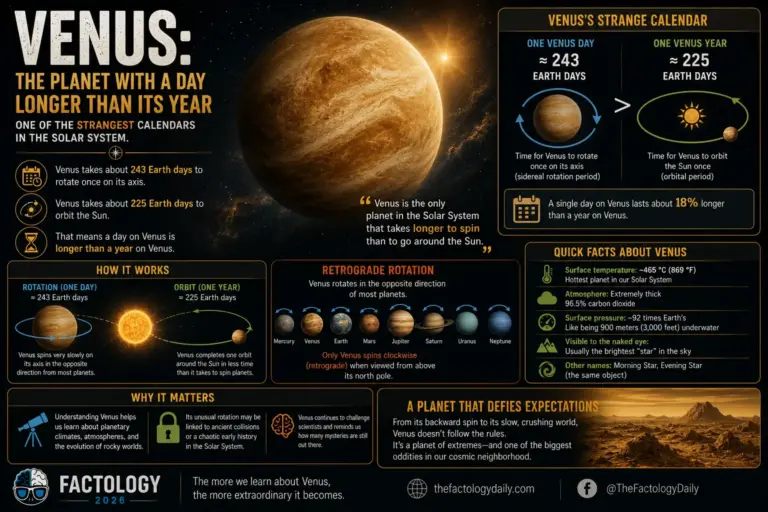
A Day on Venus Is Longer Than Its Year
Discover Mercury’s unusual sky, solar motion, and bright planets as seen from the planet, based on MESSENGER data and its 3:2 spin‑orbit lock.
Overview
Mercury, the innermost planet, lacks a substantial atmosphere, leaving its sky perpetually black even when the Sun is above the horizon. This airless environment allows an observer to see celestial objects with striking clarity, unobstructed by scattering or twilight. The planet’s proximity to the Sun creates extreme lighting conditions, while its unusual spin‑orbit coupling produces a day‑night cycle unlike any other world. From this vantage point, the motions of the Sun, Venus, Earth, and the Moon follow patterns that are both familiar and alien, offering a natural laboratory for studying planetary illumination and orbital dynamics.
Background
Mercury orbits the Sun at an average distance that yields an incident solar flux roughly seven times the Earth‑receiving solar constant, peaking near eleven times at perihelion and dropping to about four and a half times at aphelion. Consequently, the Sun’s apparent diameter varies from 1.733 degrees at perihelion to 1.142 degrees at aphelion, a change of almost sixty‑six percent in size and brightness. The planet is locked in a 3:2 spin‑orbit resonance: it completes three rotations on its axis for every two revolutions around the Sun. This resonance means that a single Mercurian solar day spans two orbital periods, making the length of a day on Mercury equal to about 176 Earth days. Because of this coupling, plotting the Sun’s position at the same clock time each day would produce only one point on the sky, yet the equation of time still yields an analemma that appears as a nearly straight east‑west line.
Key details
During a Mercurian day the Sun’s apparent motion is unusual. It rises in the east, climbs, then pauses, reverses direction for a while, and finally resumes its forward trek. If the retrograde segment occurs within a few hours of sunrise, an observer would witness two sunsets and two sunrises in the same day—sunrise, pause, backward motion, sunset, second sunrise, then normal progression. Approximately four Earth days before perihelion the orbital angular speed matches the rotational speed, causing the Sun’s apparent motion to halt; at perihelion the orbital speed slightly exceeds the rotation, making the Sun drift westward (retrograde); four days after perihelion the normal eastward motion resumes. The interval from the first glimpse of the Sun’s limb to the moment its full disk is visible takes nearly six hours, giving Mercury a notably leisurely sunrise.
Apart from the Sun, Venus is the brightest object in the Mercurian sky. When Venus is at opposition as seen from Mercury it presents its fully illuminated disk, reaching an apparent magnitude of –7.987, far brighter than any star. From Earth, Venus never shows a full face at its brightest, but from Mercury the geometry is reversed. Earth and the Moon are also conspicuous: Earth shines at about magnitude –5 and the Moon at –1.2, with their maximum separation reaching fifteen arcminutes, allowing them to be resolved as two distinct points. The Moon’s motion carries it across the Earth’s disk, and observers on Mercury have even witnessed a total lunar eclipse, as recorded by the MESSENGER spacecraft on 8 October 2014. All other planets remain visible, though they appear somewhat fainter at opposition than they do from Earth, the effect being most pronounced for Mars.
The zodiacal light—a faint glow of sunlight scattered by interplanetary dust—is more prominent on Mercury than on Earth due to the lack of atmospheric scattering. At night, Mercury’s southern sky is anchored by α Pictoris, a magnitude 3.2 star that serves as its pole star, while the northern pole is marked by Omicron Draconis. Because Mercury’s years are short (88 Earth days) and its nights are long (a single night lasts about one Mercurian year, or 1.5 sidereal days), the sky undergoes a extensive sweep. Over the course of a night the heavens rotate roughly 540°, and when combined with the ≈180° of sky already visible at sunset, nearly the entire celestial sphere passes through view. As a result, virtually every star rises and sets twice during a Mercurian night, though the exact local time of each event shifts with the observer’s longitude.
In February 2011 the MESSENGER mission released a “family portrait” of the Solar System assembled from 34 images taken by its MDIS instrument in November 2010. The mosaic shows all planets except the distant Uranus and Neptune, echoing the earlier Voyager 1 portrait from 1990. This view underscores how, even from the innermost world, the broader architecture of the Solar System can be captured in a single frame.
Why it matters
Understanding Mercury’s extreme illumination and peculiar solar dynamics helps scientists refine models of planetary atmospheres, surface heating, and orbital resonances—knowledge that is directly applicable to rocky exoplanets orbiting close to their host stars. The planet’s ability to present bright Venus, resolvable Earth‑Moon pairs, and frequent double risings of stars offers a natural laboratory for testing observational techniques that rely on precise timing and photometry. Moreover, the MESSENGER‑derived Solar System portrait demonstrates how spacecraft positioned near the Sun can contribute to our cosmic perspective, complementing outer‑system views from Voyager. By studying Mercury’s sky we gain insight into how light, gravity, and rotation interact to shape the observable universe, informing both mission planning for future probes and the interpretation of distant worlds where similar conditions prevail.
External References
For further reading see the source article: Astronomy on Mercury.
Sources