
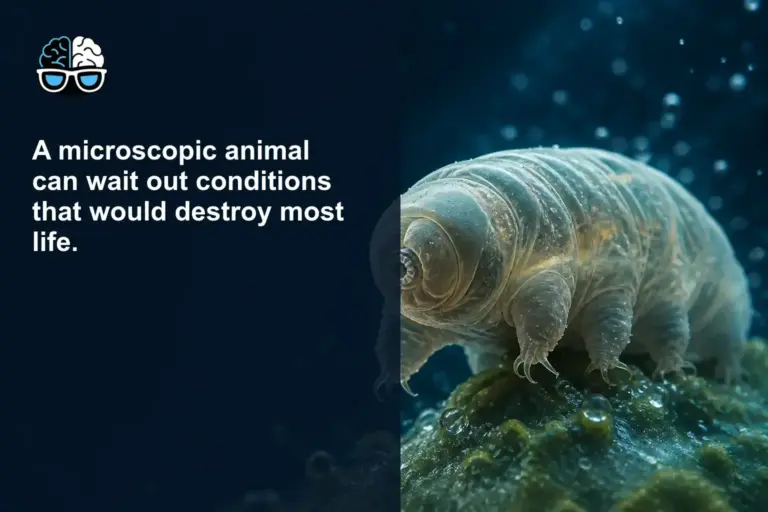
A microscopic animal can wait out conditions that would destroy most life.
Tardigrades survive extreme conditions by entering a dormant state. Learn how these microscopic animals endure environments lethal to most life forms.
Overview
Water bears, or tardigrades, are microscopic animals renowned for their ability to survive conditions that would destroy nearly all other life. These eight-legged, segmented creatures, first described in 1773 by German zoologist Johann August Ephraim Goeze, can enter a state of suspended animation known as the tun state. In this form, they withstand extreme dehydration, intense radiation, freezing temperatures, and even the vacuum of space. Their resilience stems from a unique biological adaptation that allows them to halt metabolic activity and protect their cellular structures until favorable conditions return.
Background
Discovered in the 18th century, tardigrades were initially named for their bear-like appearance, earning the nickname ‘little water bear.’ In 1776, Italian biologist Lazzaro Spallanzani coined the term Tardigrada, meaning ‘slow walkers,’ a reference to their deliberate, lumbering gait. Found in environments ranging from moss and lichen to deep-sea sediments and polar ice, tardigrades thrive in habitats where water availability fluctuates dramatically. Their survival strategy hinges on cryptobiosis—a reversible state of near-zero metabolic activity. When environmental conditions become harsh, tardigrades expel most of their body water, retract their limbs, and form a protective tun. This transformation allows them to endure years without water, temperatures from near absolute zero to over 150°C, and exposure to ionizing radiation levels thousands of times higher than what is lethal to humans.
Key details
The tun state is not merely a passive survival mechanism; it involves active biochemical processes. Tardigrades produce unique proteins called intrinsically disordered proteins (IDPs) and trehalose, a sugar that replaces water in cells and stabilizes membranes and proteins during desiccation. These compounds prevent cellular structures from collapsing and protect DNA from damage. Upon rehydration, tardigrades rehydrate rapidly, resume metabolic functions, and return to normal activity within hours. This ability has been demonstrated in laboratory experiments where tardigrades revived after being dried for over a decade.
While the source material focuses on isolated brains, the concept of biological resilience in extreme conditions shares a thematic link with tardigrade survival. Just as isolated brains can be maintained in vitro with oxygenated solutions or artificial cerebrospinal fluid, tardigrades rely on internal biochemical systems to maintain cellular integrity without external resources. Both phenomena highlight the adaptability of biological systems under duress. However, unlike the isolated brain, which requires external perfusion or nutrient support, tardigrades achieve survival through self-sustaining mechanisms that do not depend on continuous external input.
Historically, the idea of sustaining life outside the body has fascinated scientists and philosophers alike. Early experiments in the 19th century, such as Charles Brown-Sequard’s 1857 attempt to revive a dog’s head with oxygenated blood, laid groundwork for modern research. More recently, in 2023, researchers at the University of Texas Southwestern Medical Center developed an extracorporeal pulsatile circulatory control (EPCC) system to maintain pig brain function for several hours, demonstrating that cerebral hemodynamics can be regulated independently of the body. While this research focuses on neural activity and circulatory control, it underscores the broader scientific interest in preserving biological function beyond natural constraints—paralleling the tardigrade’s ability to suspend life indefinitely.
Why it matters
The study of tardigrades offers insights into extremophile biology, astrobiology, and potential applications in medicine and biotechnology. Their ability to survive space conditions has led to experiments aboard the International Space Station, where tardigrades were exposed to the vacuum and solar radiation of space and later revived. These findings suggest that life could potentially survive interplanetary travel in a dormant state, raising questions about panspermia—the hypothesis that life can spread between planets via space debris.
Understanding the molecular mechanisms behind tardigrade resilience may lead to advances in preserving biological materials, such as vaccines, tissues, and organs, without refrigeration. The proteins and sugars that protect their cells could be engineered into medical treatments to stabilize biological samples during transport or storage. Additionally, research into cryptobiosis may inform future space missions, where long-term human survival in extreme environments could depend on similar biological adaptations.
While the source material discusses isolated brains in philosophical and scientific contexts—ranging from historical experiments to fictional portrayals—the tardigrade’s natural survival strategy represents a real-world example of biological extremity. Unlike the artificial systems required to sustain isolated brains, tardigrades achieve survival through innate, self-contained mechanisms. This distinction highlights the remarkable efficiency of evolutionary adaptation in microorganisms.
External References
Sources