
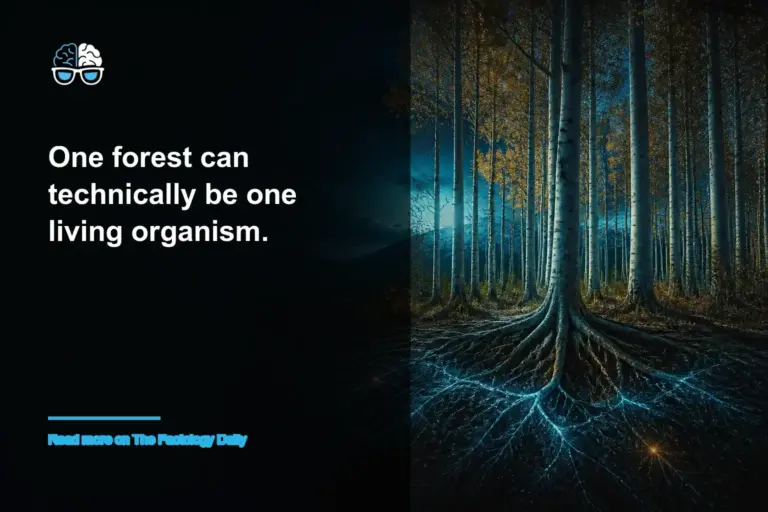
One forest can technically be one living organism.
Pando is a clonal quaking aspen colony in Utah with 47,000 stems sharing a root system, covering 40 hectares and estimated to be 14,000 years old.
Overview
Pando is a clonal colony of quaking aspen (Populus tremuloides) located in the Fishlake National Forest of Sevier County, Utah. Although it appears as a grove of individual trees, all stems are genetically identical ramets that share a single underground root system. This structure enables the colony to function as one large organism, and it is often cited as the world’s largest living entity by mass.
Background
A clonal colony, also called a genet, consists of genetically identical individuals that originate vegetatively from a single ancestor. In plants, each visible stem is referred to as a ramet, while the shared underground network may be made of roots, rhizomes, or stolons depending on the species. In fungi, the visible fruiting bodies or mushrooms are the individuals, arising from a common mycelium that remains hidden in the soil.
Although many plants reproduce sexually through seeds, some species propagate vegetatively via underground structures such as stolons or rhizomes. Above ground these plants often look like distinct individuals, but below ground they remain interconnected and are all clones of the same plant. Recognizing a clonal colony can be difficult when the spread is subterranean and the species also engages in sexual reproduction.
Key details
Pando comprises an estimated 47,000 stems, called ramets, that cover about 42.8 hectares of land, which is roughly equivalent to 106 acres. The colony is male, and each ramet is a quaking aspen that looks like an independent tree but is genetically identical to all the others.
The ramets are linked by a shared root system that allows the colony to function as a single physiological unit. Because of this shared genetics and the extensive root network, Pando is regarded as the largest tree by weight, land area, and stem count, and is frequently described as the single largest organism by weight on Earth.
Pando is also noted for its considerable age, with estimates placing it at around 14,000 years old. Other clonal colonies highlighted in the source include the King’s Lomatia in Tasmania, estimated to be 43,600 years old, and an underwater meadow of the marine plant Posidonia oceanica in the Mediterranean Sea that may reach up to 100,000 years of age.
Clonal colonies can arise through several vegetative mechanisms. In many woody plants, wide‑ranging roots periodically send up new shoots, known as suckers. Trees and shrubs whose branches can bend to the ground or form aerial roots may create colonies by layering or aerial rooting, as seen in willow, blackberry, fig, and banyan. Vines such as ivy and trumpet vine develop adventitious roots when their stems touch the soil, while others like Wisteria root at stem nodes. Ferns and herbaceous flowering plants often spread via horizontal underground stems called rhizomes, exemplified by ostrich fern and goldenrod. Many herbaceous species use surface stolons or runners, such as strawberry and various grasses. Non‑woody plants with bulbs or corms, like Narcissus and Crocus, can also form colonies, and some species produce leaf‑borne plantlets (Kalanchoe daigremontiana, Tolmiea menziesii) or asexual seeds through apomixis, as in dandelion.
Many woody species are known to form clonal colonies through shared root systems. Examples listed in the source include Bigelow oak, quaking aspen, bayberry, black locust, creosote bush, bladdernut, blueberry, devil’s club, forsythia, hazelnut, honey locust, Kentucky coffeetree, kerria, pawpaw, poplars, sassafras, sumac, sweetgum, and sweetshrub. These plants remain interconnected below ground, exchanging water, minerals, and other resources while appearing as separate stems above ground.
Why it matters
Pando’s estimated age of around 14,000 years and its coverage of over 40 hectares make it one of the oldest and most massive living organisms known. Its designation as the world’s largest tree by weight and land area further underscores its exceptional scale.
As a clonal colony, Pando illustrates how a single genetic individual can produce thousands of stems that remain interconnected through a shared root system. This combination of great age, large size, and clonal growth offers a clear example of vegetative reproduction and long‑term persistence in the plant kingdom.
External References
For a detailed explanation of clonal colonies and their formation mechanisms, see the Wikipedia article on clonal colonies: https://en.wikipedia.org/wiki/Clonal_colony. Additional information on Pando’s size and age can be found in the cited scientific literature, including Cook (1983) and Kricher & Morrison (1988).
Sources