
The Voynich Manuscript Still Resists Translation
Explore the Voynich manuscript, an undeciphered 15th‑century codex with strange illustrations and unknown script that continues to baffle scholars.
Overview
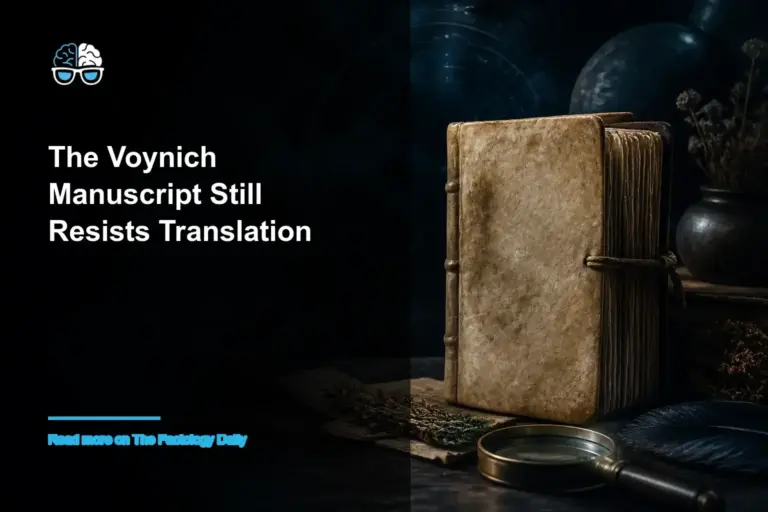
The Voynich manuscript is a hand‑written codex whose pages are filled with an unknown script and vivid illustrations. Radiocarbon dating places the vellum between 1404 and 1438, and stylistic analysis points to an Italian Renaissance origin. Since 1969 it has resided in Yale University’s Beinecke Rare Book and Manuscript Library, where it was made fully viewable online in 2020.
Illustrations fill many pages with vivid, hand‑drawn scenes that mix the familiar with the uncanny. Some folios depict plants whose leaves and roots do not match any known species, rendered in fine ink outlines and washed with crude colour. Other pages show naked women bathing in tubular pools, while astrological circles contain zodiac‑like symbols and concentric rings. Diagrams of stars and planets accompany sections of text, and occasional fold‑out sheets reveal larger schematics.
Background
The manuscript measures 23.5 by 16.2 by 5 cm and contains roughly 240 vellum pages gathered into 18 quires, though evidence suggests it may have originally held at least 272 pages in 20 quires. The parchment is calfskin, made from at least fourteen or fifteen whole skins, and shows signs of heavy use—soft texture, holes, tears, and insect damage—indicating it was handled frequently, perhaps as a medical manual or celestial almanac. Binding and covers are later goatskin additions from the time the codex was held by the Collegio Romano, and the original wooden cover is inferred from insect holes on the first and last folios. Ink analysis reveals iron gall made from a quill pen, with carbon, iron, sulphur, potassium and calcium as major components; the coloured pigments applied later are inexpensive earth‑based materials such as ground azurite for blue, egg‑white and calcium carbonate for white, a copper‑chlorine compound for green, and red ochre mixed with hematite for the red‑brown tones.
The quires have been numbered from 1 to 20 in various locations using a style of numerals consistent with those used in the 15th century, and the top right corner of each recto (right‑hand) page has been numbered from 1 to 116 using a style of numerals that originated at a later date. Gaps in these sequences suggest that, at some point in the manuscript’s history, at least 272 pages existed in 20 quires, with several leaves missing before Wilfrid Voynich acquired the codex in 1912. Evidence also indicates that many bifolios were reordered over time, so the current order of pages differs from the original arrangement.
Key details
The text runs left to right and contains about 38,000 words, of which roughly 9,000 are distinct. Most characters are formed with one or two simple pen strokes, and a core set of 20‑25 signs accounts for virtually all writing, with a few dozen rarer glyphs appearing only once or twice. There is no obvious punctuation, and the script flows continuously without the hesitations typical of encoded writing. Statistical studies show the word frequencies follow Zipf’s law, the most common term occurring about twice as often as the second‑most‑common and three times as often as the third. Linguistic analysis reveals patterns such as certain letters appearing only at word beginnings or ends, and a three‑part morphological structure (prefix, root/midfix, suffix) that resembles natural languages. Extraneous Latin script appears in a few places: a marginal signature reading “Jacobj à Tepenecz”, a line of High German “der Mussteil” near a nude figure, month names from March to December in the astronomical section, and a distorted block labelled Michitonese that mixes unknown‑script features with Latin letters. Handwriting analysis indicates a steady ductus but subtle variations in loop size, crossbar shape and stroke length between sections, suggesting the work of five different scribes rather than a single individual.
Statistical analysis shows that practically no words contain fewer than two letters or more than ten characters. Some lexical items appear only in certain sections or on a handful of pages, while others recur throughout the manuscript. The thousand or so labels attached to the illustrations show little repetition, but a few common words can repeat up to five times in a row, consistent with Zipf’s law. Pairs of words that differ by a single letter occur with unusually high frequency, a trait that would cause simple substitution decipherings to produce meaningless output. Researchers have also noted that the distribution of letters within words follows strict positional rules: certain glyphs are found only at the start of a word, others only at the end, and a third group always appears in the middle, a pattern reminiscent of Semitic scripts where final forms differ from initial ones.
Why it matters
The manuscript’s resistance to translation has attracted cryptographers, linguists, historians and artists for over a century. Early twentieth‑century codebreakers such as William Friedman, Elizebeth Friedman, John Tiltman and Prescott Currier applied wartime techniques without success, leading Elizebeth Friedman to describe statistical approaches as “doomed to utter frustration.” Modern computational studies, however, have found the text’s statistical profile comparable to that of genuine languages—showing a low second‑order conditional entropy (h2≈2) and word‑frequency distributions similar to Semitic, Iranian and Germanic tongues—while ruling out simple substitution or polyalphabetic ciphers. Researchers have proposed that the manuscript may encode one or more natural languages, possibly using two distinct encoding systems (labelled Voynich A and Voynich B) that correspond to different topical sections such as herbal, balneological and astrological content. The availability of a high‑resolution digital facsimile since 2020 allows scholars worldwide to examine the folios, pigments and stitching details without handling the fragile original, keeping the Voynich mystery an active interdisciplinary puzzle.
Scholars have entertained a wide range of hypotheses for the manuscript’s purpose and origin. Some suggest it encodes a natural language, while others propose a constructed language or a sophisticated cipher. Alternative ideas include that it is a hoax, a reference work such as a folkloric index or compendium, a product of glossolalia, or a work of fiction—ranging from science fantasy and mythopoeia to metafiction and speculative fiction. Despite decades of effort by both professional and amateur codebreakers, none of these explanations has been independently verified, leaving the Voynich manuscript as one of the most enduring enigmas in the study of medieval manuscripts.
External References
For the full description and images, see the Voynich manuscript page on Wikipedia.
Sources